I am often told, and have witnessed myself, that individuals with PDA are the best Bull Shit detectors!
PDAers are truth seekers, they will see through anything that is fake or disingenuous. They will sniff out agendas, hidden demands and expectations.
In my book, “The Educator’s Experience of Pathological Demand Avoidance” there is a constant theme that runs throughout which highlights the need for trust and connection when supporting a child with PDA.
If a PDAer works out that you are not being entirely honest and truthful with them, then this can irreparably breakdown the trust and connection that has formed, sometimes with disastrous results.
I also talk about the fact the slightest change in tone of voice, expressions and body language can be detected by the hypervigilant PDAer. I know PDAers who will pick up on their parent’s mood as soon as they walk in the front door and will know if their parents have had a difficult day and feel stressed. This can be misinterpreted as anger being directed at the child with PDA, which then causes further stress and anxiety all round!
So, this is why honesty is always the best policy, and there are many reasons why.
Firstly, if we try to hide these emotions, our PDA BS detectors are likely to pick up on this, but possibly believe that these emotions are due to something that they have done, and this will increase their anxiety. In my book I give an example of an occasion when I arrived at a school to work with a child when I was really worried and stressed about my own son. I tried to be super “professional” but within minutes of our session starting, the child asked me if I was okay, and had picked up that I was not my usual self. I was honest and truthful about my worries, because if I had said I was “fine” he would have known I was not.
So, secondly, if we are not truthful about our emotions, then we risk the relationship and trust that has been formed. That child who knew I was not “fine” may have spent our session thinking that there was something wrong and may have even thought that he was the cause of me not being myself, and I was not prepared to damage the relationship we had which was based on trust.
Thirdly, there is no such thing as a “bad” emotion. We need to teach our children that anger and anxiety, for example, are just normal, healthy emotions. We should encourage our children to express these emotions in safe and healthy ways. When we are honest about our emotions, we can help encourage our children to do the same.
Fourthly, when we our honest about our emotions we can also role model how we can manage these. We can say, “I feel a bit cross, so I am going to step out and take a deep breath” or “I feel really worried, so I am going to try and distract myself, can you tell me a silly joke?”
And as I explain in the Chapter, “The Antidote to Anxiety is Trust” when you are honest and genuine about your emotions you show your true, authentic self, which is essential to individuals with PDA, and encourage them to show you theirs too, which is essential to the trusting, reciprocal relationship you have built.
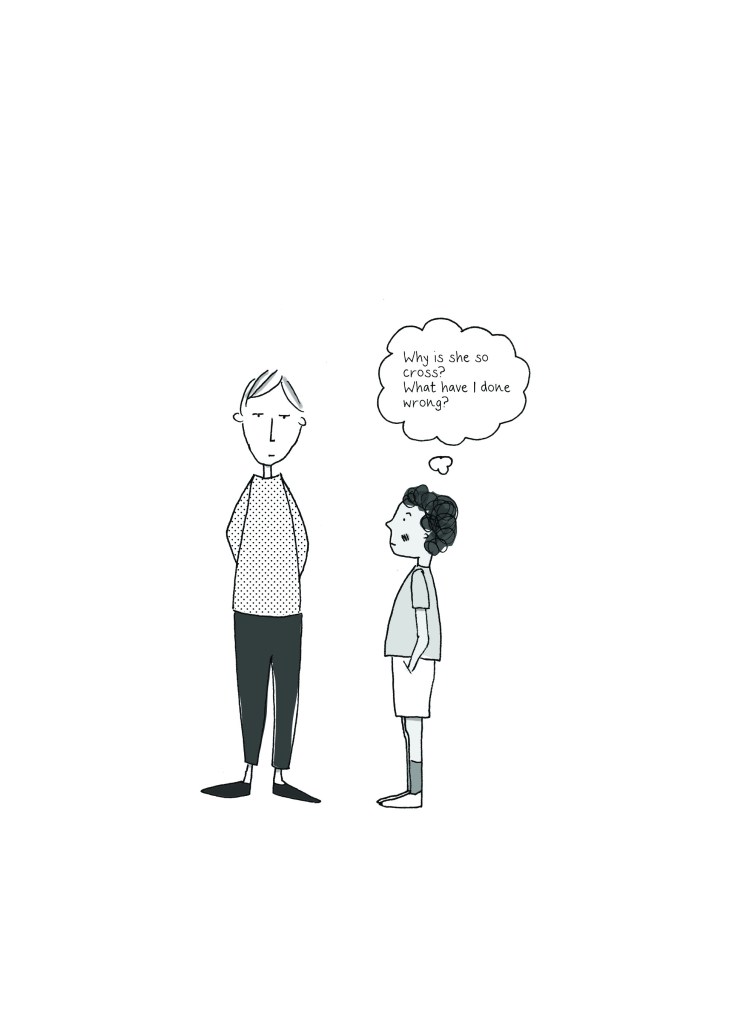
Illustration by Eliza Fricker, from “The Educator’s Experience of Pathological Demand Avoidance” published by Jessica Kingsley Publishing.
 The Neurodivergent Educator