• Sample Page

The Neurodivergent Educator

  • Going “Against The Grain”

    Jun 25th, 2023

    My book, “The Educator’s Experience of Pathological Demand Avoidance” starts with an honest confession, and that is that working with learners with PDA used to scare me.

    The reason it scared me? Because before I really understood PDA, and what learners with PDA needed, my time with PDAers was not always successful.  Sometimes I would be on the receiving end of some rather harsh verbal feedback, sometimes work I had spent hours planning got ignored or ripped up, sometimes things would get damaged or destroyed, and on a few occasions it was not just my feelings that got hurt.

    Fortunately, I realised pretty quickly that there was nothing wrong with the learners I was supporting, but there was a lot wrong with the way I was working with them. 

    It was ME that had to change, Me that had to adjust and ME that had to learn.  I had to “unlearn” a lot of what I thought I knew about autism and completely change my approach. 

    Sometimes, we have to “go against the grain,” when we are supporting neurodivergent children, whether this is as a parent or a professional.

    A lot of what we do as professionals is because that is “just the way it’s done.” It is the way we are told it should be done, or it is the way we have been trained to do it. 

    A lot of what we insist on as parents is stuff that we do because it is the way we were brought up, and the way we think that things should be done. 

    As an example, I used to insist that my children sat at the dinner table until everyone had finished their meal.  This is what I had been brought up being told I had to do, so I passed this expectation onto my children too.

    As a result, mealtimes in our house were often a source of stress and conflict, and eventually I realised that insisting that my eldest son, who has ADHD, sat, and waited for the rest of us to finish eating was a recipe for disaster most nights.  Letting him get down from the table as soon as he had finished eating cut down on a great deal of that stress and conflict, but it initially felt a little uncomfortable as it “went against the grain.”

    A few years ago, I was working with a lovely family who had a son with a PDA profile.  One morning I had a 9am consult scheduled with the dad.  He arrived at my office slightly early and slightly flustered and told me almost immediately, “I need to tell you what I did this morning, because I have gone against all my parenting instincts, and I need to talk to you about it.”  I was a little worried about what he was going to tell me and braced myself to hear it, then he told me, “I let my son watch his iPad at the breakfast table with his headphones on this morning……”

    “Aaaaaaand………………?” I asked slightly nervously.

    “We had the best morning ever!  He got to school on time, happy and I am here early too!” He told me smiling. 

    He then went on to explain that letting his son sit at the breakfast table on a screen went against all his parenting instincts and was not something he ever thought he would allow, but as we talked, he admitted that this style of parenting was how he had been brought up, and that what he had done that morning just “went against the grain.”

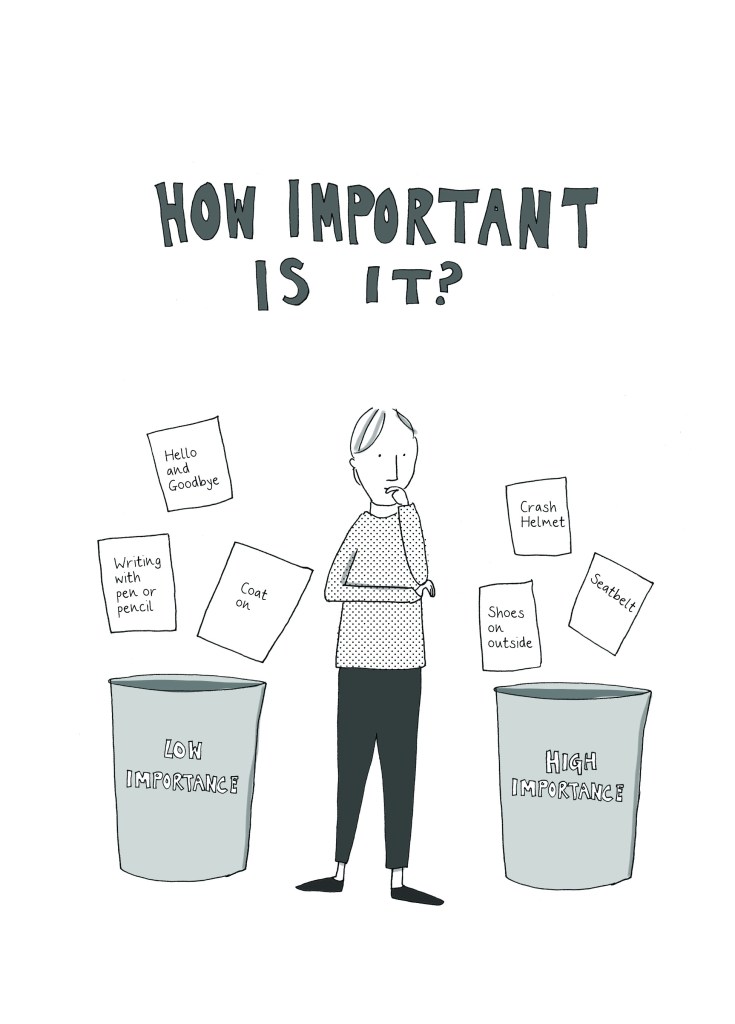
    So, we need to ask ourselves “why am I asking them to do this?  And “does it actually matter?”

    In a learning environment we can ask ourselves:

    • “Does it actually matter if they write, or I do it?”
    • “Does it actually matter if they don’t finish this piece of work?”
    • “Does it actually matter if they do PE in their school uniform?”

    And in the home environment we can ask ourselves similar questions like:

    • “Does it actually matter if they don’t eat their meal at the table?”
    • “Does it actually matter if they don’t get dressed and stay in their pyjamas for the day?”
    • “Does it actually matter if they say please and thank you?”

    For a child with a PDA profile this is particularly important as we must remember that placing demands on these children will feel like threats to their autonomy and can cause unnecessary anxiety.  This is something I talk about in my book in more detail, and is illustrated so beautifully by Eliza Fricker, AKA, Missing the Mark. 
    So, what happens when we decide to “go against the grain?”

    Initially it feels a bit “rough” and a bit uncomfortable, there may be a few “splintered” moments, but when we continue to go against the grain, it starts to feel easier and easier, and eventually it becomes so natural and smooth that everyone involved benefits.

    Oh, and by the way there is a second confession in my book and that is, “You’re not meant to have favourites when you work in education, but I do, and guess what………they all have PDA!” And the reason I love working with them so much?  Because I learned to go “against the grain.”

    Pic Credit:  Missing the Mark taken from our book, “The Educator’s Experience of Pathological Demand Avoidance”  Published by Jessica Kingsley Publishing. 
  • Why Honesty is always the Best Policy:

    Jun 13th, 2023

    I am often told, and have witnessed myself, that individuals with PDA are the best Bull Shit detectors!

    PDAers are truth seekers, they will see through anything that is fake or disingenuous.  They will sniff out agendas, hidden demands and expectations.

    In my book, “The Educator’s Experience of Pathological Demand Avoidance” there is a constant theme that runs throughout which highlights the need for trust and connection when supporting a child with PDA.

    If a PDAer works out that you are not being entirely honest and truthful with them, then this can irreparably breakdown the trust and connection that has formed, sometimes with disastrous results.

    I also talk about the fact the slightest change in tone of voice, expressions and body language can be detected by the hypervigilant PDAer.  I know PDAers who will pick up on their parent’s mood as soon as they walk in the front door and will know if their parents have had a difficult day and feel stressed.   This can be misinterpreted as anger being directed at the child with PDA, which then causes further stress and anxiety all round!

    So, this is why honesty is always the best policy, and there are many reasons why.

    Firstly, if we try to hide these emotions, our PDA BS detectors are likely to pick up on this, but possibly believe that these emotions are due to something that they have done, and this will increase their anxiety. In my book I give an example of an occasion when I arrived at a school to work with a child when I was really worried and stressed about my own son.  I tried to be super “professional” but within minutes of our session starting, the child asked me if I was okay, and had picked up that I was not my usual self.  I was honest and truthful about my worries, because if I had said I was “fine” he would have known I was not.

    So, secondly, if we are not truthful about our emotions, then we risk the relationship and trust that has been formed.  That child who knew I was not “fine” may have spent our session thinking that there was something wrong and may have even thought that he was the cause of me not being myself, and I was not prepared to damage the relationship we had which was based on trust.

    Thirdly, there is no such thing as a “bad” emotion.  We need to teach our children that anger and anxiety, for example, are just normal, healthy emotions.  We should encourage our children to express these emotions in safe and healthy ways.  When we are honest about our emotions, we can help encourage our children to do the same.

    Fourthly, when we our honest about our emotions we can also role model how we can manage these.  We can say, “I feel a bit cross, so I am going to step out and take a deep breath” or “I feel really worried, so I am going to try and distract myself, can you tell me a silly joke?”

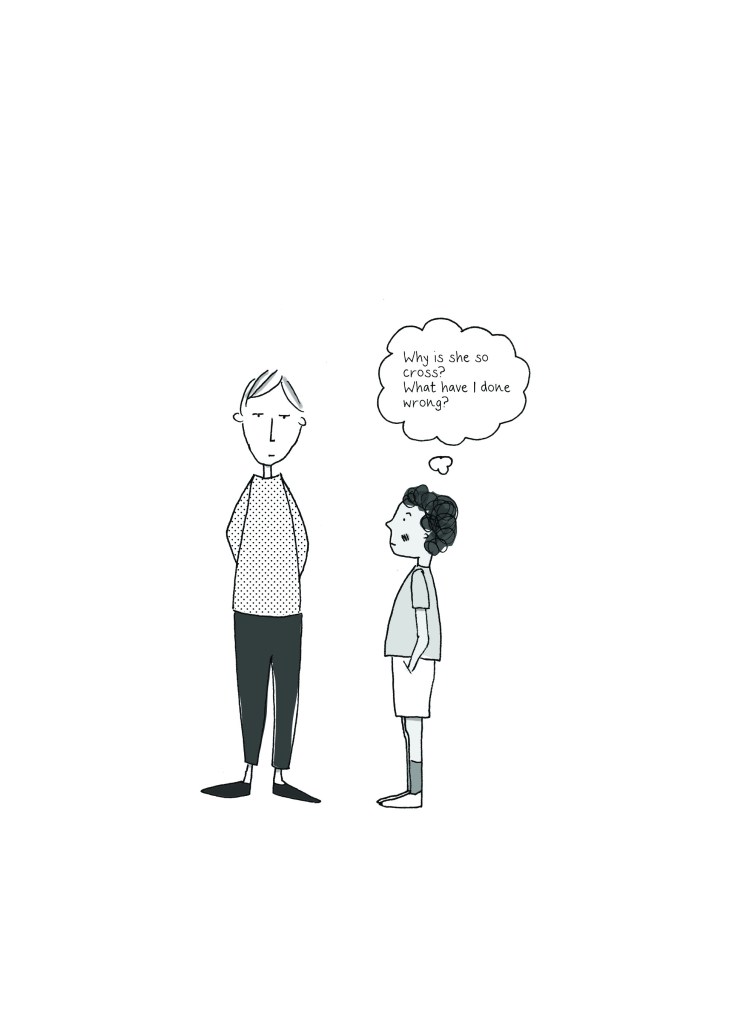
    And as I explain in the Chapter, “The Antidote to Anxiety is Trust” when you are honest and genuine about your emotions you show your true, authentic self, which is essential to individuals with PDA, and encourage them to show you theirs too, which is essential to the trusting, reciprocal relationship you have built.

    Illustration by Eliza Fricker, from “The Educator’s Experience of Pathological Demand Avoidance” published by Jessica Kingsley Publishing.
  • Remember to Look at what You can’t See.

    Jun 2nd, 2023

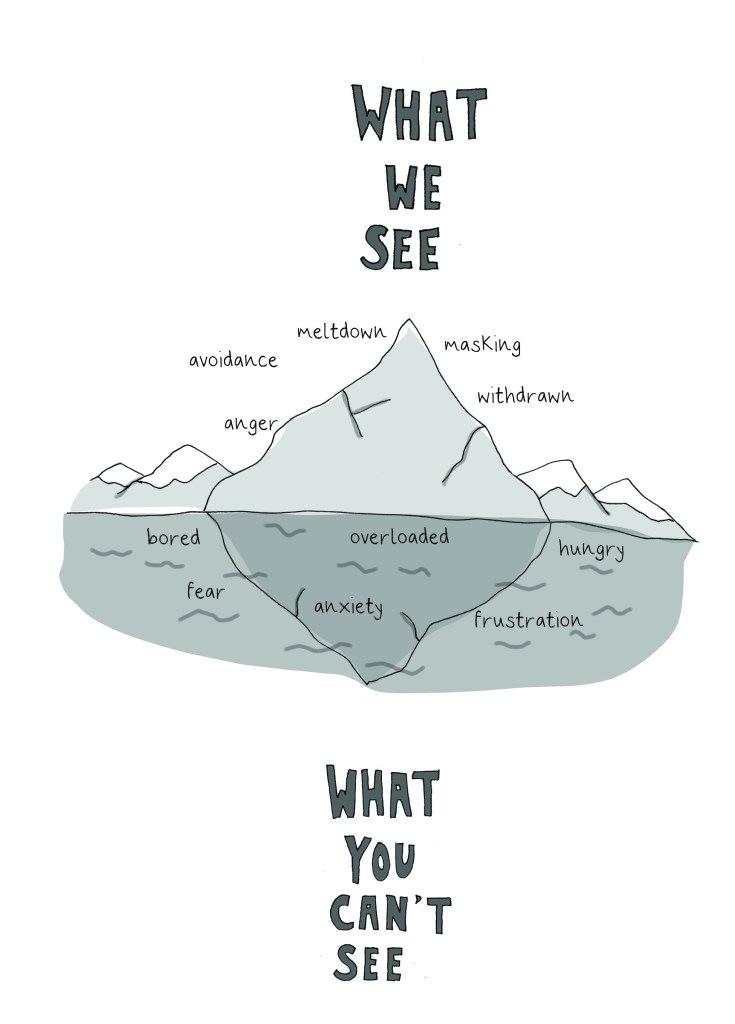
    When I am delivering training I use “The Iceberg” analogy in all my presentations.

    When we are supporting individuals with their behaviour one of the the biggest mistakes that we make is that we only focus on the behaviour that we see and not look for the unseen underlying reason, causes and triggers.

    This means that the behaviour we are trying to support will remain the same, as the things that are causing it also remain the same.

    This is a mistake that I have made myself as a parent, but it was a mistake that also proved to be a very valuable lesson for me too. 

    About 10 years ago we holidayed in Nerja in Spain. We rented an absolutely beautiful villa high up in the hills (we called it a mountain) of Nerja.

    We were all SO excited about this holiday, and I had pictured myself lying in the shade reading as my sons splashed happily in the pool.

    The villa was accessed by a winding road that snaked up the side of “the mountain” and when we arrived, we were all blown away by the stunning views down to Nerja and the sea.

    We had only been at the villa for half an hour when we informed the boys that we needed to go to the shops. My youngest, Fin, bitterly complained about doing this stating that he “hadn’t come on holiday to go shopping” and questioning why he had to come. I explained I couldn’t leave a 6-year-old in a villa on their own in Spain, so he argued my husband should go alone. Further explanation and some bribing persuaded Fin to come to the supermarket and he reluctantly got in the car and came with us.

    That evening we decided to go to Nerja Town for pizza, something the boys would normally love to do, but was met with “why do we have to go out AGAIN?” by Fin. “He’s just tired” I told myself.

    As the first part of the holiday went by I had very little time to relax and read as I had hoped. Fin was grumpy, difficult and didn’t want to go anywhere. He made his older brother’s life difficult and was punchy and constantly rude. I spent a lot of time intervening fights and arguments, feeling more and more resentful that my holiday was not the relaxing break I had hoped for.

    Fin’s mood permeated into the family, I accused him of being ungrateful, spoilt and ruining the holiday for the rest of us. I even resorted to my own mum’s classic line of, “Do you know how many children have never been on a holiday before? Let alone to a villa in Spain!”

    I’m ashamed to admit this now but I also told Fin if he was having such an awful time we could arrange for him to fly back home and stay with my parents for the duration of the time away. My words fell on deaf ears and only seemed to make things worse.

    I couldn’t understand why my little boy who was so excited about this holiday was so unhappy.

    Then I realised I was only seeing his behaviour. I was not looking at the reasons why. Of course Fin wanted to be happy and enjoy his holiday just as much as we did – something was clearly going on “under the surface” that was preventing this.

    I was focussing far too much on what I wanted out of the holiday, without considering what Fin wanted or needed.

    I took Fin into the villa and sat with him and said, “Fin, I can tell you are really unhappy on this holiday and I want to help you feel better, please tell me what’s up.”

    Fin looked up at me and tearfully, “I can’t tell you mummy because I don’t want to spoil your holiday.” I reassured Fin that if he told me what was wrong, I would do my best to help and he burst into proper tears.

    He told me he was terrified of leaving the villa. He thought that if we took one false move driving up and down the winding mountain track to the villa that we would plummet to certain death! “What if another car comes up or down the track?!” He asked me “What would we do then?!”

    I reassured Fin that my husband is a very good driver, I also realised that as he was so small at the time that he couldn’t see what I could, and that there were no sheer drops. I told Fin we could go for a walk down the track where he could get a better perspective of the track and see that it was actually safe.

    I asked Fin if there was anything else on his mind. Again that little face looked at me with tears in his eyes and said, “There is one other thing mummy- what’s rabies?!” Yes, Fin had tuned in to a conversation we had had in the car when my husband had decided to avoid dropping our rubbish at the communal bins as there were stray dogs mooching about very nearby because “they may have rabies!” My eldest son had enquired about this and my husband had informed him, “it’s a terrible disease you can get if you get bitten by a dog – you go completely mad and they have to use the biggest needle in medicine to give you an injection!”

    Fin was terrified the mountains around the villa were full of rabid dogs waiting to pounce.

    So there we had it. The reasons for my sons “behaviour.”

    He wasn’t being rude, ungrateful, spoilt or difficult. He was absolutely terrified. He was scared to leave the safety of the villa in case he plummeted to his death, and if he defied death and made it into Nerja then he was terrified of being mauled by rabid dogs!! All of this was being made worse by a fear that he was spoiling the holiday he knew we had all been looking forward to.

    My mistake was that I wasn’t considering the “unseen” reasons for my sons behaviour. I was only focusing on what I could see – and how this was impacting on me.

    Fin and I left the villa after our chat and went for a walk. He felt much better after seeing the track from a different perspective, and whilst we walked we talked about rabies and how rare it was. We agreed that if he saw a dog whilst we were out he would tell me so I could keep him safe.

    When we left the villa that night, we gave Fin the job of locking the villa gates, this helped him feel he was keeping the villa secure but also distracted him. We let Fin choose the music when we got in the car (again to distract him) and we ensured he sat in the car away from the edge of the track. My husband also drove more slowly (instead of pretending to be a rally driver as he had before!)

    I’m pleased to say that Fin was so much happier following on from this, and the rest of the holiday was so much more enjoyable for all of us. Our chat had opened a conversation where he could share his worries and fears, instead of fearing he was spoiling our holiday.

    But – I never forgot the lesson I learned on this holiday – that the behaviour that we “see” is always a result of the things that we can’t. And unless we address and support those unseen needs and fears, our children cannot be expected to “change their behaviour.”

    Our job as parents and professionals is to help identify the hidden needs that drive the behaviours that we view as “challenging.”

    As parent and professionals, we need to look for the things that we cannot see, particularly things like anxiety, sensory processing difficulties and social communication differences and try to understand and support these. 

    There is far too much expectation on children to change their behaviour, particularly in schools – but unless WE, the adults, address and support those unseen needs and fears, those “behaviours” will not and cannot change.

    Image taken from “The Educator’s Experience of Pathological Demand Avoidance” illustrated by Eliza Fricker and published by Jessica Kingsley Publishing.
  • Drowning in Anxiety.

    May 13th, 2023

    When I am delivering training, I use an analogy that explains how we can help support someone who is in crisis or who is overwhelmed by their anxiety.

    Imagine that you are walking past a body of water, like a canal, and you realise that there is someone in that water, and that they are not swimming, but drowning.

    They call out for help, and you reach out your hand to try and pull them out.  You manage to get a grip with this person, but then they slip from your grasp.  As they flounder in the water, they start shouting at you, “Get me out!  Just fucking get me out!!”

    In this moment, you would not consider that they were shouting, or swearing at you.  You would understand that this person was just terrified, not consciously swearing and shouting, just desperate.

    You would not walk away, offended that they had sworn, you would just increase your efforts to help them out.

    When we are supporting neurodivergent individuals we must remember that when they are in crisis they are drowning in their anxiety.

    We have to ignore the secondary behaviours such as swearing and swearing, understanding that this is coming from a place of fear and anxiety, and focus our attention on support, validation, care and trust.

    When I work with young people, they often tell me that the one thing that they need when they are in crisis is space, yet often they do not get this.  As they spiral into overwhelm the people supporting them use too much language, offer too many choices, give too many directions, and crowd their personal space.  They may see the anxiety as “poor behaviour” and start to talk about consequences, or worse use ultimatums. 

    An individual who is in crisis is not able to say, “Excuse me, I feel really anxious, would you mind terribly giving me a bit of space until I feel calmer?”  So, they may communicate their need for space by becoming mute, running away, hiding, or lashing out verbally or physically.

    I remember once there was an incident at the school where I was a Head Teacher.  After the incident I had a de-brief with the member of staff who had been involved.  It transpired that this young person was outside a classroom, and when asked by the member of staff why he wasn’t in class, he told her to “Fuck off!”  The staff member immediately started to tell the child off, telling him not to speak to her like that, and of course the situation spiralled.  I told this member of staff to consider the fact that the child was outside the lesson because they were trying to regulate, and that the next time a child in this situation told her to “fuck off” she should do exactly that.

    On the few occasions that I was told where to go by a student or hurt by them they would often come and find me afterwards to apologise and even explain, but they needed time to process the situation before they were ready to do that.  It was also essential that I considered my own roles in any incidents and thought about if there was anything that I could have done differently too.

    Another analogy that I use in my training is that of a boiled kettle.  When you put your kettle on to boil for that first hot drink of the morning, it probably only takes about a minute or two to reach boiling point, but it will take considerably longer, up to an hour perhaps, for the kettle to go back to room temperature again.  This is like someone who has been in crisis, often it appears that they have reached, “boiling point” very quickly, but are not given enough time to “cool down” afterwards.

    Now think about what happens if you press the “On” button on when your kettle is still warm; it will reach boiling point far more quickly the second time.  This again is similar to a person who has been in crisis if they are triggered again.    

    After someone has been in crisis we should not blame, shame or punish.  We offer comfort, space if requested, reassurance, validation and empathy.  We don’t force an apology, an explanation or reason. 

    We remind the individual that we love them and care about them, and that we are there for them, however rough or smooth the water may be. 

  • But, aren’t we all a bit Demand Avoidant at times?

    May 7th, 2023

    But aren’t we all a little bit demand avoidant?


    This is a question I’m asked occasionally when I’m speaking about or delivering training on Pathological Demand Avoidance (PDA).

    The answer is “Yes – we are!”

    We will all naturally avoid things we find:

    Boring
    Frightening
    Painful
    Overwhelming
    Uncomfortable etc

    I can be very demand avoidant at times. I have ADHD, so I will procrastinate and avoid things that I don’t find stimulating such as:

    Report writing
    Accounting
    Admin
    Housework

    NICE, (The National Institute for Health and Care Excellence) lists demand avoidance as a possible feature of autism.  Within a PDA profile of autism often demands are avoided for no apparent or “rational” reason. 

    I am extremely proud to work with two multi-disciplinary assessment teams, work that I find very interesting, but also work that comes with a real responsibility to get absolutely right. Which is why, when completing an assessment for PDA we don’t just look at the avoidance of demands.

    We look at how demands are avoided.
    Why demands are avoided.
    The type of demands that are avoided.

    PDA is often described as a type of autism characterised by “an anxiety driven need to be in control.” But what is equally, if not more important, to an individual with PDA than the need for control is the need for autonomy. PDA is now often thought of as, a “Pervasive Drive for Autonomy” (Tomlin Wilding) or a “Persistent Drive for Autonomy” (Dr Wenn Lawson) which I actually prefer to “Pathological Demand Avoidance.”

    PDAers are not avoiding demands because they are being willingly oppositional, “naughty,” defiant or difficult. PDAers are unable to comply with demands because they are a threat to their autonomy, and this threat causes an unavoidable and overwhelming anxiety response such as fight, flight, freeze, fawn etc.

    Often demands are not refused or rejected obviously, rather they are avoided subtlety, and cleverly using distraction, excuses, delaying techniques, flattery, creativity and charm.

    It’s essential to remember that it is not that the individual with PDA doesn’t WANT to comply demands, the fact is that they CAN’T comply with them, and that is a very important difference. 

    A PDAer may genuinely want to do something, but then as soon as someone acknowledges, expects or encourages their desire to do it, then “Bam!” the autonomy that the PDAer needs is removed and replaced with overwhelming anxiety which means the demand has to be rejected so that autonomy is retained.

    In an excellent video made by the PDA Society, “Demand Avoidance of the PDA Kind,” https://www.youtube.com/watch?v=CCsfKxyuH1I&t=150s there is a quote from a child who says:

    “When somebody tells me to do something, my brain says, “no” so I think up different excuses why I can’t do it, it’s really hard sometimes.  I don’t want people to be disappointed with me.” 

    Think about that for a second………this is a child who puts considerable thought an energy into the feelings of others, not a child who doesn’t care about your feelings or response to the fact that they cannot cope with or comply with the demands that are being placed upon them. 

    But, it’s not just external expectations and demands which cause anxiety and demand avoidance for an individual with PDA.   Internal expectations and demands also remove the feeling of autonomy and control that a PDAer needs. The result? PDAers will avoid things they WANT to do, as well as things they don’t. Imagine how frustrating, upsetting and conflicting this must be for them. 

    When parenting or supporting an individual with PDA, we must always remember their need for autonomy and the anxiety that is caused when this is taken away, threatened to be removed, or perceived to be taken away. 

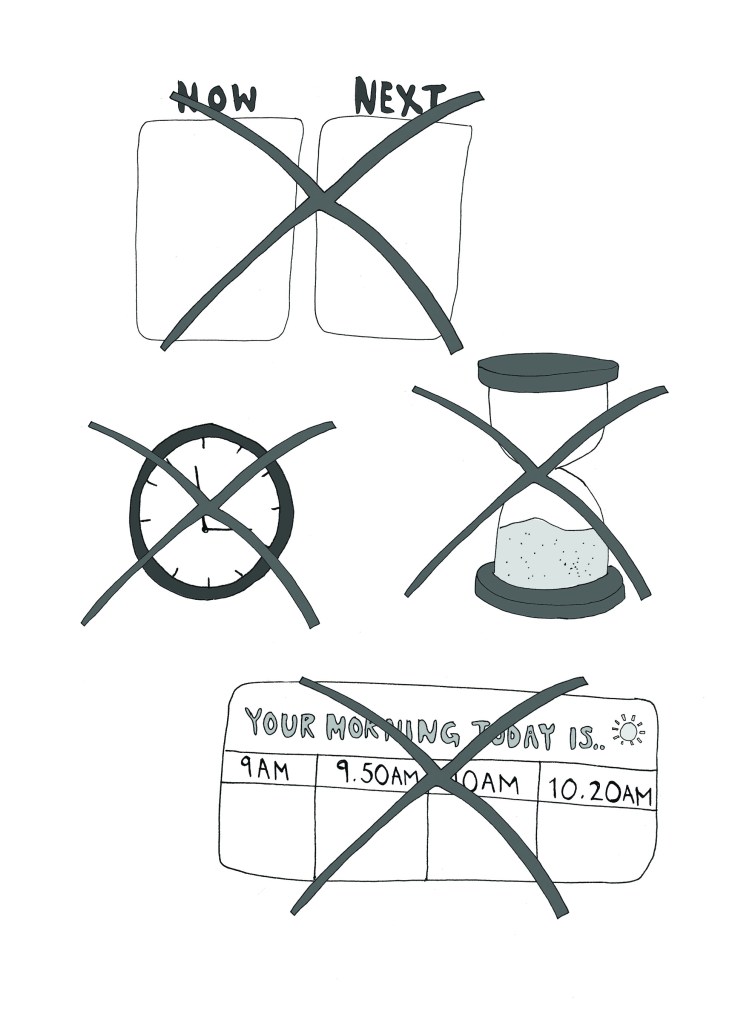
    PDAers will do everything that they can to protect their autonomy, which is why the traditional approaches and strategies that can work so successfully for non-PDA autistic individuals which are routed in routine, structure and predictability, do not work, and can actually be counter-productive for an individual with a PDA profile. 

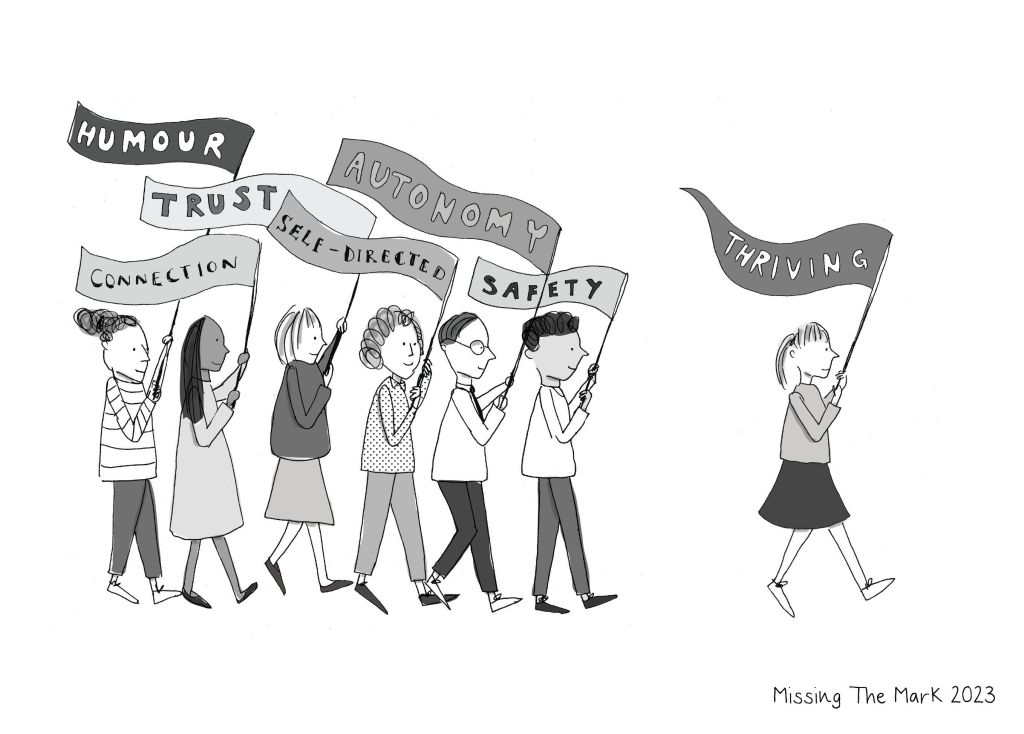
    Individuals with PDA don’t need “strategies”, as well as autonomy they need:

    • Connection
    • Trust
    • Safety
    • Choices
    • Flexibility
    • Meaning
    • Understanding
    • Empathy
    • Validation
    • Novelty
    • Authenticity

    And, when given the above, you will see all the amazing characteristics of an individual with PDA, and you will see them thrive!

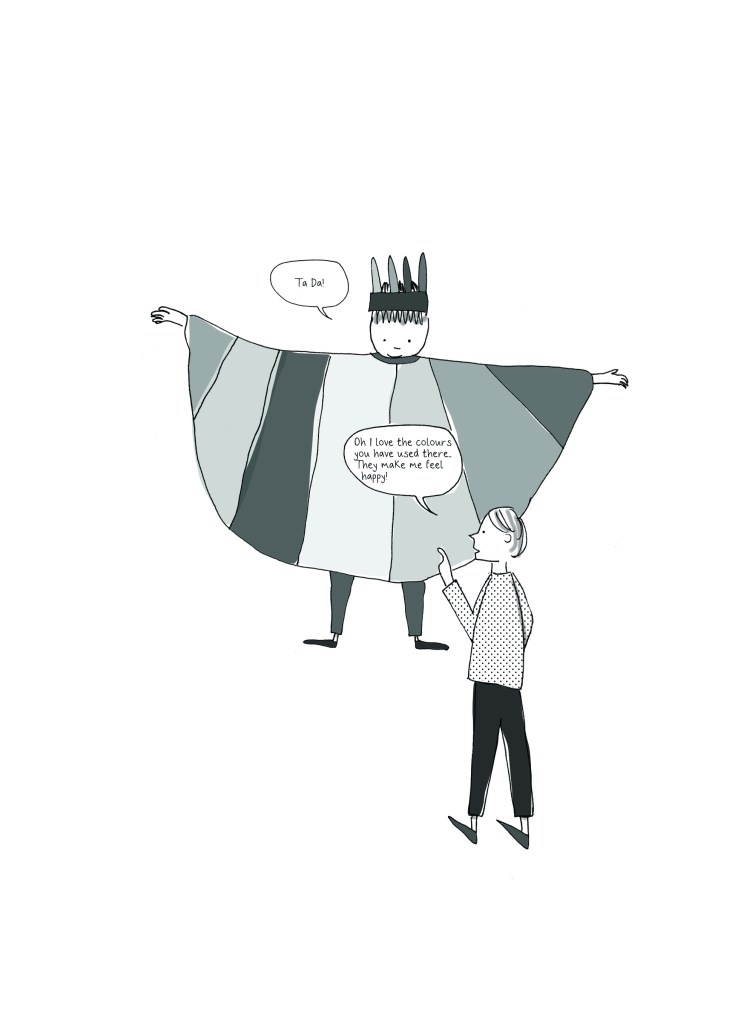
    Images by Eliza Fricker, taken from the book, “The Educator’s Experience of Pathological Demand Avoidance” published by Jessica Kingsley Publishing. 

    For more information on assessments with Positive Assessments Support and Training (PAST) visit: 

    https://p-ast.co.uk/assessments

    For more information about PDA visit:

    HOME
  • The Importance of Connection.

    May 4th, 2023

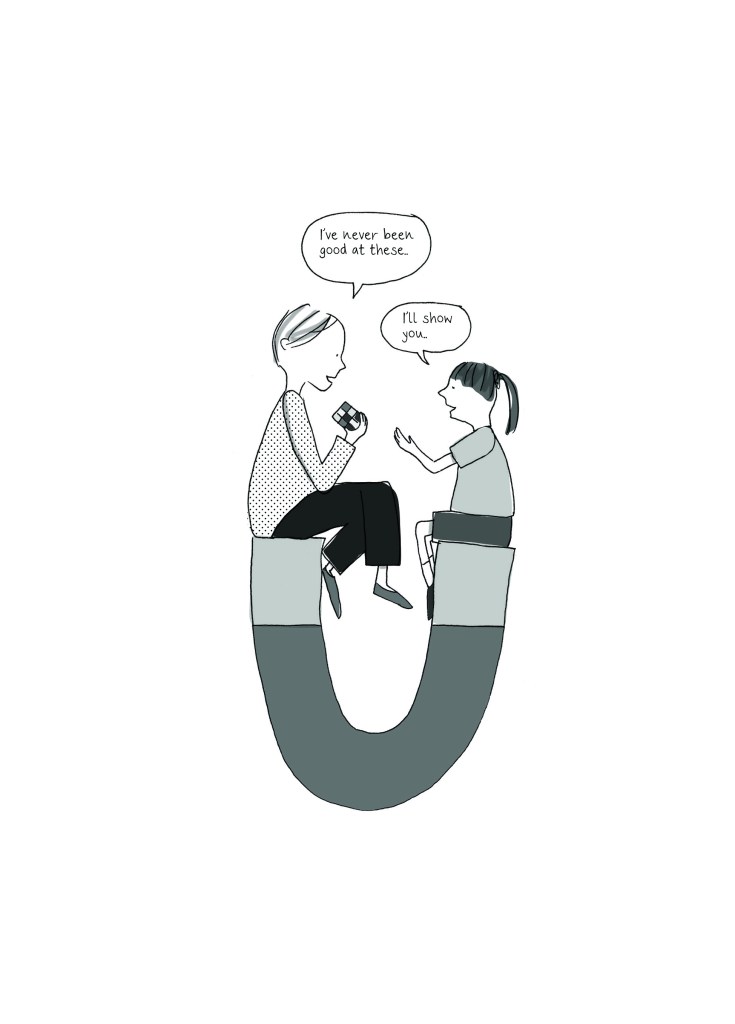
    Two weeks ago my book, “The Educator’s Experience of Pathological Demand Avoidance” was published. The book is filled with beautiful illustrations by the brilliant Eliza Fricker, AKA Missing the Mark. I have been asked a few times since the release if I have a favourite illustration, and although it is a hard choice to make, since I love them all, I keep coming back to this one from the chapter on “Making Connections.”

    An anxious child cannot learn, and the antidote to anxiety is trust, this is why, for learners with PDA, trusting connections are everything.

    Connections have to be genuine, authentic, equal and reciprocal.

    Trying to force a child with PDA to make a connection or comply with demands is like trying to force the same poles of two magnets to touch – it’s never going to happen!! A PDAer will repel demands, and repel from some people like a magnet repels from another magnet that is the “wrong” way round.

    But, if you put 2 magnets close enough to each other the “right way” round they will pull towards each other and naturally connect.

    You have to do exactly the same around children with PDA. You have to change your direction, you have to change your approach, you stop trying to force anything to happen. You have to take your time, let the child “be” and share a genuine interest in their interests.

    You build up trust, reduce anxiety and THEN you build a natural connection.

    When learning is facilitated rather that directed, in a way that is autonomous and interest lead the child will be drawn to it, excited by it and engaged. When you learn with someone, and work on tasks together, learning and goals are shared and therefore the demands of learning are reduced too.

    When you get it right with these incredible children, show them respect and build equal, trusting and reciprocal relationships then rather then being repelled they will be drawn to you and the learning experiences you can share together.

    Eventually, once that connection and that trust is made you join together as equals. You stick together, you share the demands and you can become the most incredible force learning about and achieving amazing things together……

    “The Educator’s Experience of Pathological Demand Avoidance” illustrated by Eliza Fricker and published by Jessica Kingsley Publishing is available now on the JKP website, Amazon and all good book shops.

  • Why I LOVE EOTAS!

    Apr 2nd, 2023

    Five years ago, a colleague and I discussed the increasing number of children who we were meeting through our work as autism and education consultants who were unable to access their education within a school or college.  Almost all these children were neurodivergent, bright and wanting to learn, they just could not do it within the confines of the national curriculum and within the environment of a school building.  Many of these children had experienced trauma as a result of their time within the education system and were now suffering from emotionally based school avoidance. 

    As a result of this conversation we set up Kite Therapeutic Learning, an organisation that provides bespoke education packages to children through EOTAS  packages.  When we first started, we had 6 children on our books.  We now have over 50 with a waiting list and work with over 60 fantastic tutors and Learning Support Assistants. 

    We hold regular meetings with our learner parents and team members.  Words that we often hear in meetings include, “transformative” and “life changing.”  Children who have been described previously as “hard to teach,” “unwilling to learn” or “difficult to engage” become excited once again by learning, under the careful guidance and support of adults that they have learned to trust. 

    Quite simply, I think EOTAS is amazing, the impact it has on children’s lives is incredible.

    Here is why I love it so much:

    EQUITY:  EOTAS programmes must be one of the most equitable types of education that exists.  Children are supported according to their own unique strengths and needs.  EOTAS programmes recognise that not all children are able to do the same thing at the same time and allows children to work at their own pace.  Children can make rapid progress, without boundaries, and can slow down, pause or change direction when needed too. 

    ORIGINAL:  Every single EOTAS programme is unique, original and tailor made to learners needs.  No two programmes are the same and programmes can be adapted and changed as children’s interests and passions change.

    TRANSFORMATIVE:  I hear this word so much from parents who have children who have EOTAS.  EOTAS can literally transform children’s mental health, their feelings about education and their future opportunities.  The impact of EOTAS can send positive ripples through entire families.  Children who have previously been described as “defiant,” “oppositional” and “challenging” become engaged, interested and excited by learning. 

    AUTONOMOUS:  EOTAS allows true autonomy.  Learners are the absolute HEART of their programmes.  THEY are in charge of what they want to learn about and when.  EOTAS programmes can adapt and change as learners’ interests change.  Children learn because they want to, how they want to, about the things that they see the value in.

    SAFE:  Learners who have EOTAS form safe, trusting, reciprocal connections with adults who can share their interests and passions.  For children who have had such negative, traumatic experiences in education this can take time, but EOTAS allows them the time they need, and the safe connections that are formed are the most important foundation of their education.

    Here is a wonderful quote from one of our parents at Kite, “‘Thomas is now formally “educated other than at school”, with his learning provided by a specialist team. He has built up an excellent rapport with them, and they’ve created a curriculum around his special interests. There are still days when he can’t cope, but the team can work flexibly as his needs change.
     
    ‘Being “educated other than at school” has helped Thomas to regain his trust of education and adults and has rebuilt his fragile confidence and feelings of self-worth. His world is still small and his anxiety is still high, but he’s happier, more aware of his emotions, and is slowly becoming more open to learning.’

    I just WISH so much, that EOTAS was not regarded as “less than” education that is provided in a school.  I also wish that it was not so hard for children to get EOTAS agreed by Local Authorities.  Parents have to fight SO hard to get EOTAS often only finally being awarded this fare more appropriate form of education through expensive and stressful tribunals.  This means that precious time and learning opportunities are lost for these brilliant children who do so well once EOTAS has finally been awarded to them.

    EOTAS does not have to be forever.  At Kite we celebrate the progress that our learners make, and last year were delighted when three of our learners were able to transition into mainstream colleges, their mental health greatly improved and their faith in the education system and the adults who work in it transformed.

    Pic Credit: Missing the Mark

  • New beginnings……

    Mar 18th, 2023

    The last two weeks have been incredibly stressful for me. Old trauma has resurfaced leaving me incredibly anxious, confused and not knowing who to trust.

    One of my favourite sayings that I use in my work is, “The antidote to anxiety is trust.” I use this when explaining the need for learners to be able to thrive by having staff in their educational settings that they can forge strong, trusting connections with. These last few weeks, as a neurodivergent adult my trust in people and the community that I considered myself to be a part of has been shaken to the core.

    I know I have a lot to offer the community, and that many neurodivergent children and their families and professionals who work with them have benefitted from my voice, it does not seem fair to them that my voice is removed, so I have found another way to be heard……………and this blog is that way.

    Although it will take me time to recover from the shock and upset of the last few weeks, I know that I will recover with the help of my amazing friends; my “Neurodivergent Squad.”

    I hope you enjoy and benefit from what I have to say, and what is yet to come.

    Laura x

  • Hello World!

    Mar 18th, 2023

    Welcome to WordPress! This is your first post. Edit or delete it to take the first step in your blogging journey.

Blog at WordPress.com.


Loading Comments...
 

    • Subscribe Subscribed
      • The Neurodivergent Educator
      • Already have a WordPress.com account? Log in now.
      • The Neurodivergent Educator
      • Subscribe Subscribed
      • Sign up
      • Log in
      • Report this content
      • View site in Reader
      • Manage subscriptions
      • Collapse this bar