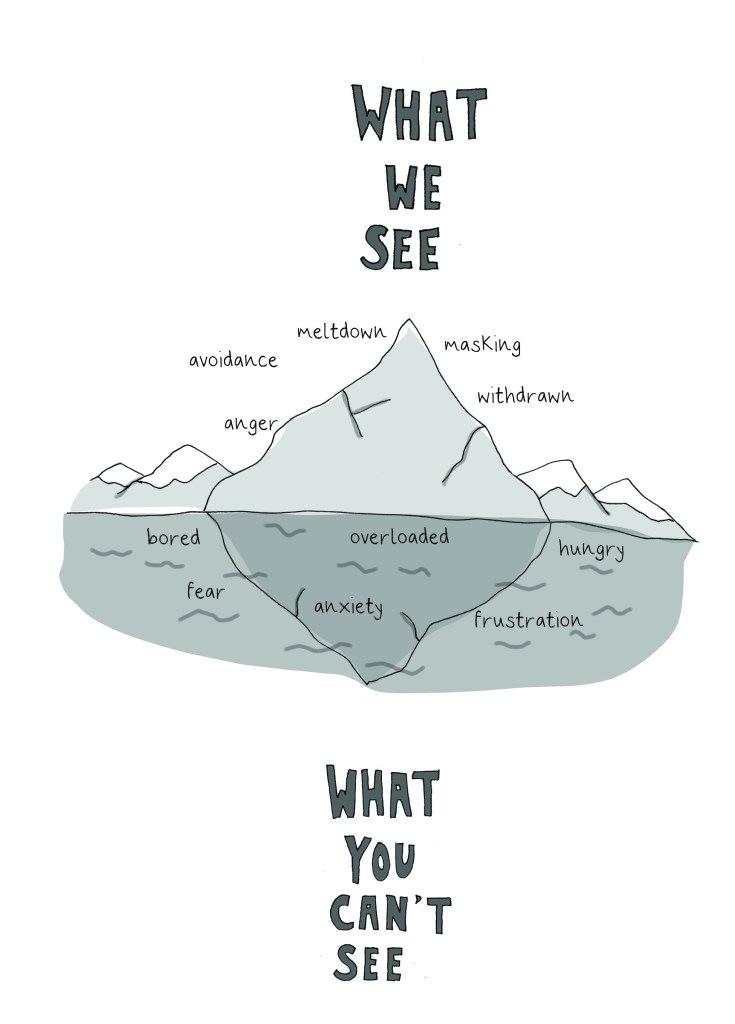
When I am delivering training I use “The Iceberg” analogy in all my presentations.
When we are supporting individuals with their behaviour one of the the biggest mistakes that we make is that we only focus on the behaviour that we see and not look for the unseen underlying reason, causes and triggers.
This means that the behaviour we are trying to support will remain the same, as the things that are causing it also remain the same.
This is a mistake that I have made myself as a parent, but it was a mistake that also proved to be a very valuable lesson for me too.
About 10 years ago we holidayed in Nerja in Spain. We rented an absolutely beautiful villa high up in the hills (we called it a mountain) of Nerja.
We were all SO excited about this holiday, and I had pictured myself lying in the shade reading as my sons splashed happily in the pool.
The villa was accessed by a winding road that snaked up the side of “the mountain” and when we arrived, we were all blown away by the stunning views down to Nerja and the sea.
We had only been at the villa for half an hour when we informed the boys that we needed to go to the shops. My youngest, Fin, bitterly complained about doing this stating that he “hadn’t come on holiday to go shopping” and questioning why he had to come. I explained I couldn’t leave a 6-year-old in a villa on their own in Spain, so he argued my husband should go alone. Further explanation and some bribing persuaded Fin to come to the supermarket and he reluctantly got in the car and came with us.
That evening we decided to go to Nerja Town for pizza, something the boys would normally love to do, but was met with “why do we have to go out AGAIN?” by Fin. “He’s just tired” I told myself.
As the first part of the holiday went by I had very little time to relax and read as I had hoped. Fin was grumpy, difficult and didn’t want to go anywhere. He made his older brother’s life difficult and was punchy and constantly rude. I spent a lot of time intervening fights and arguments, feeling more and more resentful that my holiday was not the relaxing break I had hoped for.
Fin’s mood permeated into the family, I accused him of being ungrateful, spoilt and ruining the holiday for the rest of us. I even resorted to my own mum’s classic line of, “Do you know how many children have never been on a holiday before? Let alone to a villa in Spain!”
I’m ashamed to admit this now but I also told Fin if he was having such an awful time we could arrange for him to fly back home and stay with my parents for the duration of the time away. My words fell on deaf ears and only seemed to make things worse.
I couldn’t understand why my little boy who was so excited about this holiday was so unhappy.
Then I realised I was only seeing his behaviour. I was not looking at the reasons why. Of course Fin wanted to be happy and enjoy his holiday just as much as we did – something was clearly going on “under the surface” that was preventing this.
I was focussing far too much on what I wanted out of the holiday, without considering what Fin wanted or needed.
I took Fin into the villa and sat with him and said, “Fin, I can tell you are really unhappy on this holiday and I want to help you feel better, please tell me what’s up.”
Fin looked up at me and tearfully, “I can’t tell you mummy because I don’t want to spoil your holiday.” I reassured Fin that if he told me what was wrong, I would do my best to help and he burst into proper tears.
He told me he was terrified of leaving the villa. He thought that if we took one false move driving up and down the winding mountain track to the villa that we would plummet to certain death! “What if another car comes up or down the track?!” He asked me “What would we do then?!”
I reassured Fin that my husband is a very good driver, I also realised that as he was so small at the time that he couldn’t see what I could, and that there were no sheer drops. I told Fin we could go for a walk down the track where he could get a better perspective of the track and see that it was actually safe.
I asked Fin if there was anything else on his mind. Again that little face looked at me with tears in his eyes and said, “There is one other thing mummy- what’s rabies?!” Yes, Fin had tuned in to a conversation we had had in the car when my husband had decided to avoid dropping our rubbish at the communal bins as there were stray dogs mooching about very nearby because “they may have rabies!” My eldest son had enquired about this and my husband had informed him, “it’s a terrible disease you can get if you get bitten by a dog – you go completely mad and they have to use the biggest needle in medicine to give you an injection!”
Fin was terrified the mountains around the villa were full of rabid dogs waiting to pounce.
So there we had it. The reasons for my sons “behaviour.”
He wasn’t being rude, ungrateful, spoilt or difficult. He was absolutely terrified. He was scared to leave the safety of the villa in case he plummeted to his death, and if he defied death and made it into Nerja then he was terrified of being mauled by rabid dogs!! All of this was being made worse by a fear that he was spoiling the holiday he knew we had all been looking forward to.
My mistake was that I wasn’t considering the “unseen” reasons for my sons behaviour. I was only focusing on what I could see – and how this was impacting on me.
Fin and I left the villa after our chat and went for a walk. He felt much better after seeing the track from a different perspective, and whilst we walked we talked about rabies and how rare it was. We agreed that if he saw a dog whilst we were out he would tell me so I could keep him safe.
When we left the villa that night, we gave Fin the job of locking the villa gates, this helped him feel he was keeping the villa secure but also distracted him. We let Fin choose the music when we got in the car (again to distract him) and we ensured he sat in the car away from the edge of the track. My husband also drove more slowly (instead of pretending to be a rally driver as he had before!)
I’m pleased to say that Fin was so much happier following on from this, and the rest of the holiday was so much more enjoyable for all of us. Our chat had opened a conversation where he could share his worries and fears, instead of fearing he was spoiling our holiday.
But – I never forgot the lesson I learned on this holiday – that the behaviour that we “see” is always a result of the things that we can’t. And unless we address and support those unseen needs and fears, our children cannot be expected to “change their behaviour.”
Our job as parents and professionals is to help identify the hidden needs that drive the behaviours that we view as “challenging.”
As parent and professionals, we need to look for the things that we cannot see, particularly things like anxiety, sensory processing difficulties and social communication differences and try to understand and support these.
There is far too much expectation on children to change their behaviour, particularly in schools – but unless WE, the adults, address and support those unseen needs and fears, those “behaviours” will not and cannot change.
Image taken from “The Educator’s Experience of Pathological Demand Avoidance” illustrated by Eliza Fricker and published by Jessica Kingsley Publishing.
 The Neurodivergent Educator